
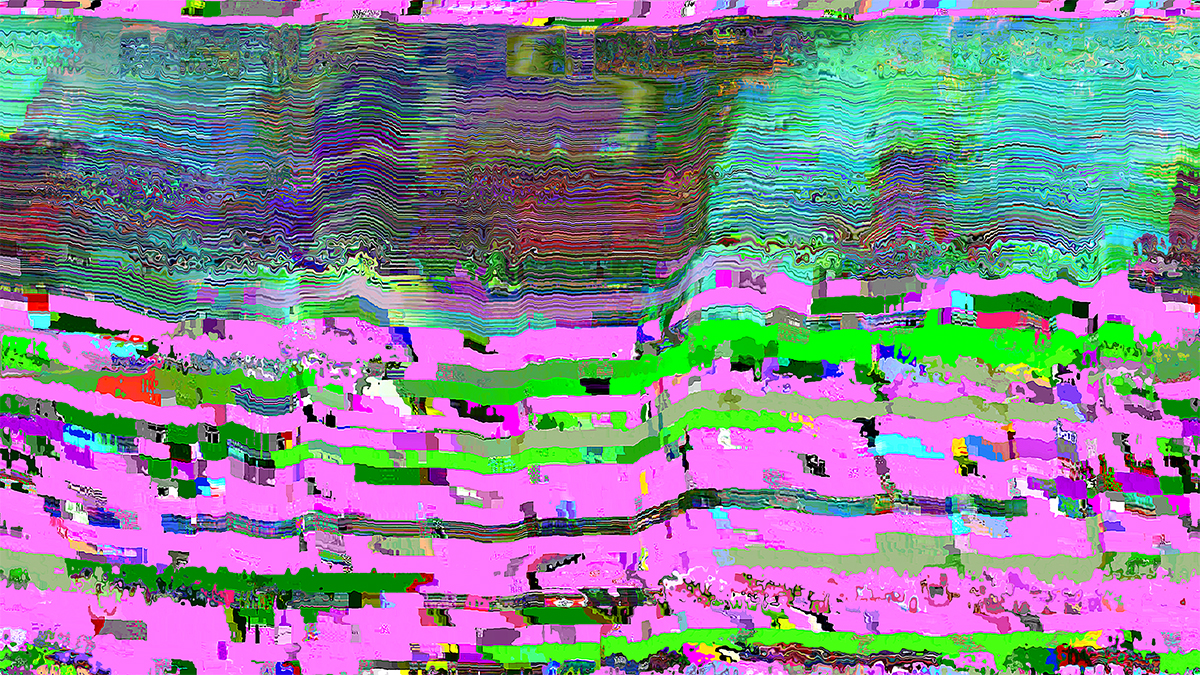
Datamoshing: The act of removing and or replacing the I-frames (delta keyframes) and or P-frames from a compressed video datastream causing the playback image and motion-vector data to distort with unpredictable & glitched results resulting in trippy, safe & legal LSD-like visuals. The aesthetic this produces is colorful and abstract and is a great way t break the realism and natural appearance of images and videos.
Modern compressed files have very complex methods of reducing the amount of storage or bandwidth needed to display the content. To do this most formats don’t store the entire image for each frame.
Frames which store an entire picture are called I-frames (Intra-coded), and can be displayed without any additional information.
Frames which don’t contain the entire picture require information from other frames in order to be displayed, either previous or subsequent frames, these frames are called P-frames (Predicted) and B-frames (Bi-predictive). Instead of storing full pictures these P-frames and B-frames contain data describing only the differences in the picture from the preceding frame, and/or from the next frame, this data is much smaller compared to storing the entire picture — especially in videos where there isn’t much movement.
When a video is encoded, or compressed, a combination of these types of frames are used. In most cases this means many P-frames with I-frames interspersed at regular intervals and where drastic visual changes in the video occur.
If an I-frame is corrupted, removed or replaced the data contained in the following P-frames is applied to the wrong picture. In the above video I-frames have been removed and so instead of scenes changing properly you see the motion from a new scene applied to a picture from a previous frame. This process of corrupting, removing or replacing I-frames is a very popular video datamoshing technique.
Another video datamoshing technique involves selecting one or more P-frames and duplicating them multiple times consecutively. This results in the same P-frame data being applied to one picture over and over again, accentuating the movement and creating what’s known as a Bloom effect.
EXAMPLE:
; Remove next 10 I-frames
^f::
Loop 10 {
	Send,{Up}
	Sleep, 500
	Send,[
	Sleep, 500
	Send,{Right}
	Sleep, 500
	Send,]
	Sleep, 500
	Send,{Delete}
	Sleep, 1000

 --BLANKBRAIN--