
The Following is the FAQ from the GLI.TC/H website: http://gli.tc/h/
WHO IS GLI.TC/H?
This is a complicated question, but we’ll do our best to answer it. Maybe we’ll start with the ‘we’ answering this question. The voice speaking on behalf of GLI.TC/H is a core group of organizers which at present include Nick Briz, Rosa Menkman and Jon Satrom. In 2010 we co-founded GLI.TC/H, along with Evan Meaney. Collectively we refer to ourselves as the gli.tc/h/bots.
It takes considerable effort to put on an event like GLI.TC/H, and the gli.tc/h/bots haven’t done it alone. The first iteration of GLI.TC/H was held in Chicago in 2010 and received support from a handful of institutions and individuals. The department of Film, Video, New Media and Animation at the School of the Art Institute of Chicago provided substantial support that year, thanks in large part to jonCates, the present chair of the department. A handful of local venues hosted free events including Roxaboxen Exhibitions, Transistor, the Nightingale Theater and Club Foot.
For GLI.TC/H 2011 (referred to as 20111) we expanded the event significantly and with that came more work and more help. The events held in Chicago, IL and Amsterdam, NL, were primarily organized and curated (from an open call) by Nick Briz, Rosa Menkman and Jon Satrom with significant organizational help from William Robertson. Kim Asendorf curated the online gallery. Theodore Darst and Evan Meaney co-curated the screening component. Antonio Roberts, with support from Arts Council England, Birmingham City University. fizzPOP, helped at the closing day of GLI.TC/H at VIVID gallery in Birmingham, UK. Additionally, Jessica Westbrook assisted in the production of the GLI.TC/H READER[ROR] and jonCates and Jake Elliott live broadcasted the Chicago events on Numbers.fm. The venues which hosted GLI.TC/H 20111 were, MBLabs, Rodan, Enemy and the Nightingale Theater in Chicago, and STEIM and PlanetArt in Amsterdam. GLI.TC/H 20111 was financially made possible through donations on Kickstarter As well as artists who donated their work to the Kickstarter; Melissa Barron, Nick Briz, jonCates, Jeff Donaldson, Evan Meaney, Rosa Menkman, Don Miller, Pox Party (Jon Satrom and Ben Syverson) and Vaudeo Signal (Ben Baker-Smith and Evan Kühl). A list of the backers can be found here.
This year, GLI.TC/H 2012 (referred to as 2112) is again being organized by Nick Briz, Rosa Menkman and Jon Satrom with the individual threads being organized by Beth Capper,jonCates, Curt Cloninger, Jake Elliott,Benjamin Gaulon, Shawné Holloway, Daniel Temkin, Adam D Trowbridge and Jessica Westbrook with additional threads by Ryan T Dunn,Kyoung Kim, Edwina Portocarrero and Philip Stearns and panels by Kevin Carey, Ted Davis, Steven Hammer, Paul Hertz,Shawné Holloway, Chris Lindgren, A Bill Miller, Alex Myers, Patrick Quinn, Antonio Roberts, Daniel Rourke and Alfredo Salazar-Caro. The events will be hosted at MBLabs, High Concept Labs, The Gallery Formerly Known as Happy Dog and Tritriangle. All the work being exhibited and performed this year will be co-produced by the online WorkingGroup participants and anyone who attends the thread sessions during the event. GLI.TC/H 2112 is financially made possible by a grant from the Propeller Fund and the support from this years Kickstarter donars.
Lastly, GLI.TC/H would be an empty room if not for the artists, theorists and enthusiasts which have participated in the past. An incomplete list of artists can be found here.
WHAT IS A GLITCH?
A glitch is an unexpected, non- or mis-understood break in a technological flow that for a moment reveals (gives a window into), its system. Though a glitch doesn’t have to be digital, it often refers to a digital error or ‘bug’. Generally, it can be anything from a skipping CD in a cafe to compression artifacts during a video chat.
WHAT IS GLITCH ART?
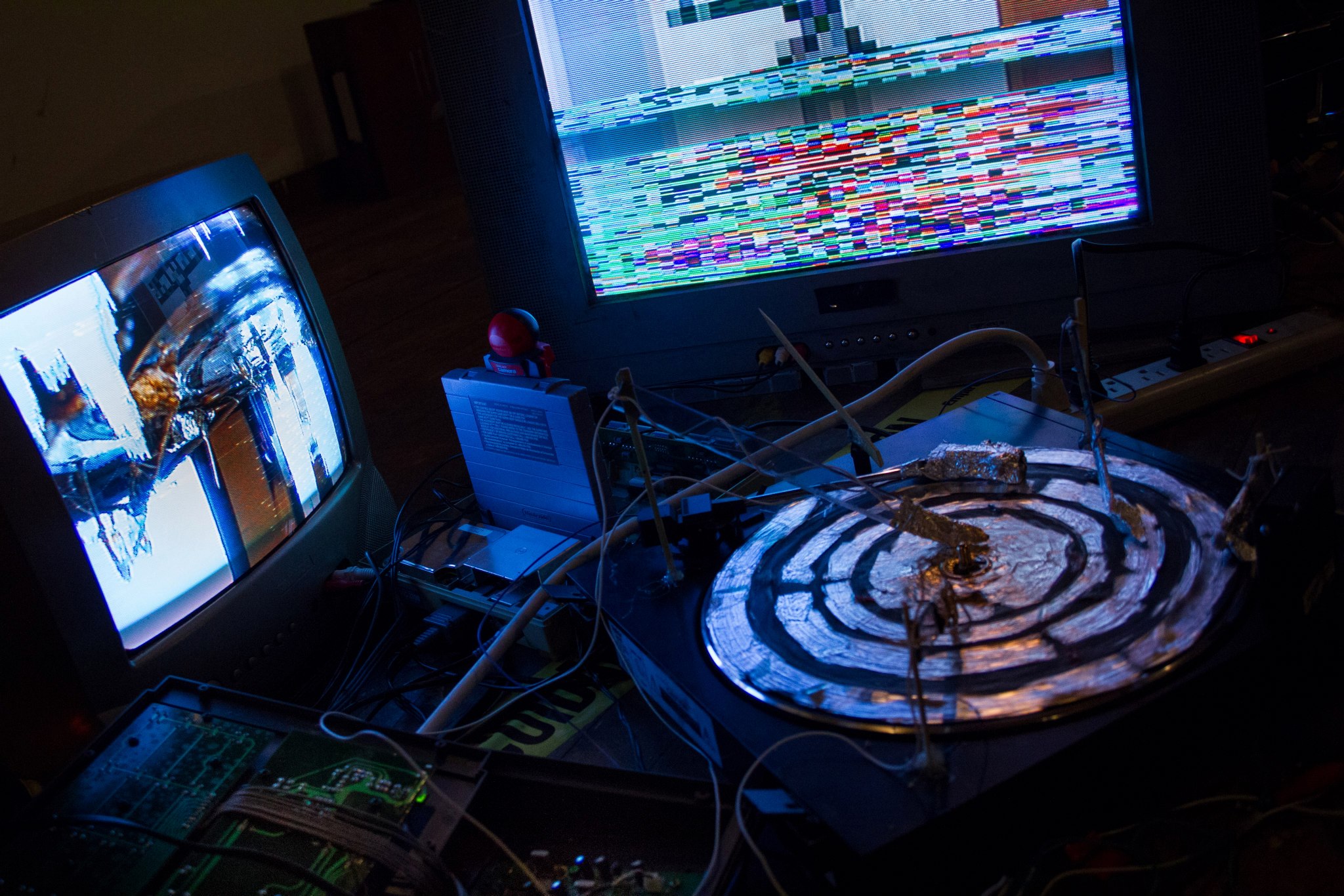
Glitch art usually refers to the intentional provocation or appropriation of a glitch by an artist. Glitch artists investigate and collect glitches to make work in many mediums (sound, web, images, video, realtime audio video performances, installations, texts, videogames, artware or software art, etc) for many different reasons (to explore the aesthetic and conceptual potential of glitches, to examine the politics embedded in technological systems, to create digital psychedelic and/or synesthetic experiences, to practice hacktivism, to explore themes of failure, chance, memory, nostalgia, entropy, etc). An incomplete list of glitch artists can be found and edited here.
Writers and academics are also very interested in the theoretical discourse surrounding this practice. An incomplete list of books, essays, articles and dissertations on the subject of glitch art can be found and edited here.
WHAT IS GLI.TC/H?
GLI.TC/H (pronounced G – L – I – dot – T – C – slash – H) has had four iterations and is presently being developed and maintained by Nick Briz, Rosa Menkman and Jon Satrom with help of many others. Founded in 2010, GLI.TC/H has been self-described as a conference, festival and gathering hybrid. It has always been a free and open event, taking place in Chicago (2010, 20111, 2112), Amsterdam (20111) and Birmingham (20111), and aims to gather glitch artists, theorists, coders and enthusiasts for a short time, to share their work and ideas. In the past (2010 and 20111) GLI.TC/H held a call for works, from which the organizers have curated gallery exhibitions, video screenings, realtime audio/video performances, lectures, workshops, panels and online exhibitions. GLI.TC/H has featured the works of over 100 artists from over a dozen countries. In 2010 GLI.TC/H launched a research wiki, which functions as a glitch art resource. It includes theoretical texts, tutorials, a list of glitch artists, past and future glitch related events (not exclusive to GLI.TC/H events) and lists online glitch communities. It is open to contributions and has been in development since 2010. In 2011 GLI.TC/H released a collection of essays and text art called the GLI.TC/H READER[ROR] published by Unsorted Books (ISBN: 978-4-9905200-1-4).
This year (2112), rather than having a call for works, GLI.TC/H has held a call for threads. These threads (lead by thread facilitators) are open groups invested in exploring a particular aspect or theme of glitch art from either a theoretical or practice based perspective. At present, these threads exist as open conversations on the GLI.TC/H working groups (forums) and will eventually take place as series of 3 hour sessions (similar to classes or think tanks) at the physical GLI.TC/H events in Chicago from Dec 6 – 9, 2012. The work produced in these threads (referred to as thread output) will be featured in the next GLI.TC/H READER[ROR] and/or online and/or in the evening exhibitions and real time performances being held in Chicago from Dec 6 – 9. Participation in these threads is free and open to anyone (deeply or mildly) interested in glitch art, as are the evening exhibitions of thread output.
WHERE DID GLI.TCH/H GET STARTED?
In 2010 GLI.TC/H hosted artists, academics and enthusiasts from all over the world in Chicago, IL. Events where held at Roxaboxen Exhibitions, the Gene Siskel Film Center, The SAIC Flaxman Theater, Transistor, the Nightingale Theater and Club Foot.
IS THERE AN ONLINE PRESENCE?
GLI.TC/H is not only the name of the event, but also its web address (http://gli.tc/h). The website contains event information but functions primarily as a portal to the wiki page, the working groups and our social media presence (facebook, twitter and tumblr blog).
The GLI.TC/H Wiki is a growing collection of resources maintained by the gli.tc/h/bots and co-developed by the glitch communities at large. The research wiki includes theoretical texts, software and tutorials, links to glitch artists websites, past and future events (not exclusive to GLI.TC/H events) and links to other online groups. It is open to contributions and has been in development since 2010.
The Working Groups are (at present) online forums used to develop ideas and projects related to the threads being held during GLI.TC/H 2112. These discussions are open to anyone interested in developing work and ideas along these themes.
GLI.TC/H also recently launched a Github account, where we have open sourced many of the applications/projects we’ve developed for and in conjuction with the GLI.TC/H.
WHEN DID THIS ALL GET STARTED?
Preperation and development for GLI.TC/H began in April of 2009, but the first event wasn’t held until September 29, 2010 in Chicago. In 2011, GLI.TC/H held events in Chicago from November 3rd through the 6th, in Amsterdam from the 11th through the 12th and in Birmingham, UK on the 19th.
WHY MAKE GLITCH ART?
Artists, theorists and tinkerers are drawn to the practice for a plethora of different reasons. As a process, glitch art breaks the digital down to it’s core and exposes the technical (and sometimes other) systems at play; for instance, ‘databending’ allows code at a ‘machine’ level to be ‘touched’. Simply put, the aesthetic output of such processes can be engaging, alarming, and beautiful; it can also be used as a tool to leverage the age old themes of failure, chance, memory, nostalgia, entropy, etc.. Teaching and sharing various glitching processes can harness the glitch to address issues of digital literacy.
Chance and randomness can provide a playful structure within the glitching process. The pseudo-science and fuzzy-logic embedded in a dirty approach have an attraction to artists who like to reverse-engineer. A glitch can call attention to technological and social issues like planned obsolescence, patents, and consumer ‘upgrade’ culture.
Some artists are interested in the structural aspects of glitch, as it has potential to expose and critique systems that govern us individually and collectively. Glitches can be used to challenge language, communication and hegemonic systems for interfacing and interacting both physically and online. Some artists encounter spirits and realms within the cracks of digital media that become fodder for meditations and/or digital psychedelia.

 --BLANKBRAIN--